
-
By Engitech Expo
-
March 5, 2026
- 0 Comment
Multi-Category Industrial Exhibitions Boost Business Growth 2026
Industrial business growth in 2026 looks very different from what it did even five years ago. Markets are more competitive, machinery investments are larger, and decision-making cycles are faster. Buyers no longer rely only on catalogues, distributor visits, or online research. They want comparison, demonstration, negotiation, and confidence — all in one place.
That is exactly why multi-category industrial exhibitions such as Industrial Exhibition 2026 in Ahmedabad are gaining momentum across the manufacturing ecosystem.
Single-industry trade fairs usually stick to one niche. You might attend one that’s only about machine tools, or another focused purely on automation. That can be useful, but in reality, factories don’t run on just one type of technology. They rely on a mix of equipment — machines, handling systems, power solutions, safety gear, and more — all working together.
When an exhibition brings all these categories into the same space, it feels more aligned with how businesses actually operate. Manufacturers can look at the bigger picture, suppliers can understand real operational needs, and buyers can compare complete solutions instead of isolated products. That kind of environment naturally speeds up conversations, decisions, and ultimately, business growth.
Let’s explore why.
The Shift in Industrial Buying Behavior
In 2026, industrial buyers are more strategic than ever.
A purchase head evaluating a CNC machine is not only thinking about the machine itself. They are considering:
Power consumption
Automation compatibility
Material handling integration
Maintenance cost
Workforce safety
Return on investment timeline
These decisions involve multiple departments — production, finance, operations, and management. A multi-category exhibition allows buyers to evaluate complementary technologies in one visit. Instead of attending three different trade shows across the year, they can compare integrated solutions in a single event.
This shortens the evaluation cycle significantly.
Cross-Industry Exposure Creates New Opportunities
One of the biggest advantages of multi-category exhibitions is unexpected discovery.
A hydraulic press manufacturer may discover laser marking integration opportunities.
A solar solution provider may connect with industrial machinery builders.
A safety equipment supplier may partner with automation integrators.
When industries intersect, innovation accelerates.
This cross-category exposure often leads to partnerships that would never happen in a narrowly focused exhibition. Businesses don’t just generate leads — they build ecosystems.
Faster Lead Generation in High-Density Environments
Multi-category exhibitions typically attract a diverse visitor base:
Factory owners
Plant managers
Procurement heads
Distributors
System integrators
Engineering consultants
When multiple sectors are represented, visitor volume increases naturally. More importantly, visitor intent improves.
A buyer attending a multi-category exhibition usually has broader investment plans. Instead of purchasing a single machine, they may be upgrading an entire production line. That means higher-value discussions and larger order potential.
Four days of concentrated networking can sometimes generate six months’ worth of qualified leads.
Real-Time Demonstrations Build Trust Quickly
Industrial purchases are rarely impulsive. They require technical clarity and confidence.
Seeing machinery in a brochure is one thing. Watching it run in front of you is something else entirely.
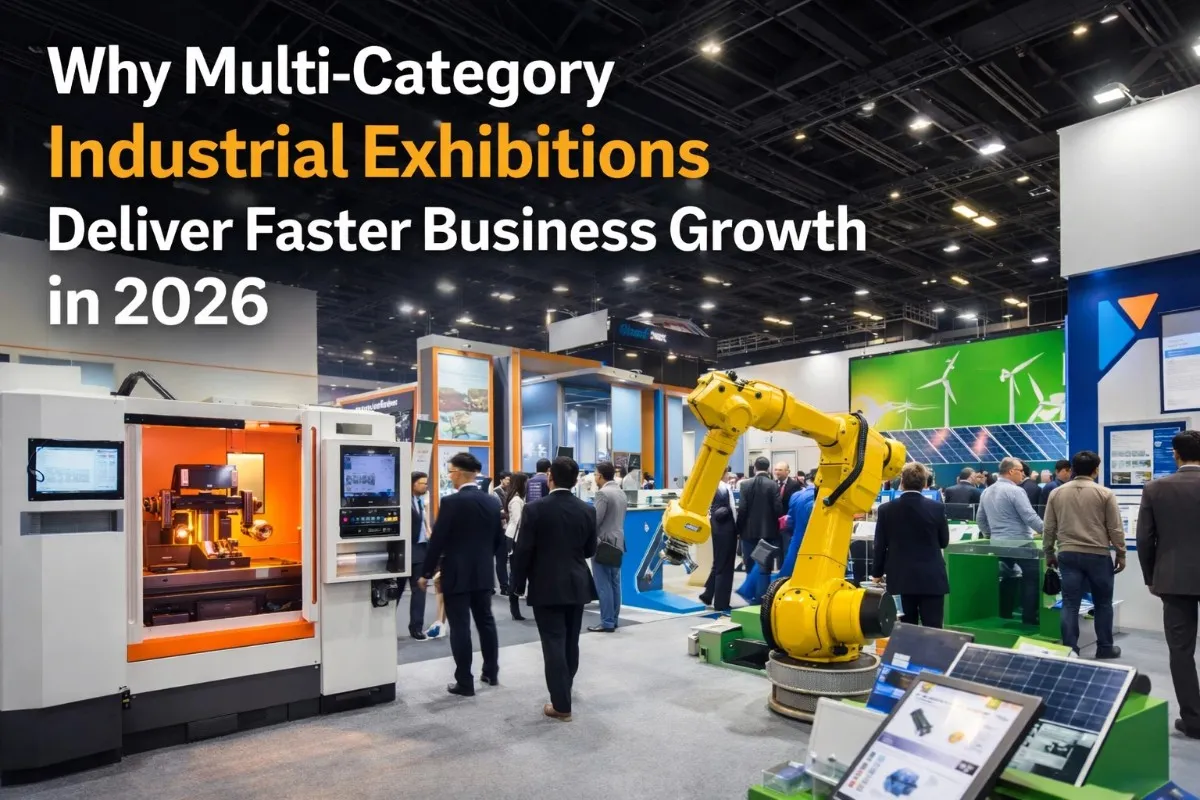
When CNC machines are cutting live, a hydraulic press is operating on the floor, automation systems are moving in real time, and material handling equipment is lifting actual loads, buyers get a much clearer picture of what they’re investing in. It’s no longer theory — it’s performance happening right in front of them.
And when different technologies are displayed side by side, it becomes easier to understand how everything might work together inside a real factory setup. You can walk a few steps and compare options, ask questions, and connect the dots immediately.
Confidence grows naturally in that setting. Machines are running, not just displayed. Technical teams are available to explain details without hesitation. Pricing and specifications can be discussed openly. Even comparing one brand against another becomes easier because everything is visible in the same space.
That kind of atmosphere makes decision-making feel more grounded and far less risky.
Reduced Marketing Cost Per Lead
From an exhibitor’s perspective, marketing budgets must justify measurable returns.
Participating in multiple niche exhibitions increases:
Logistics costs
Stall design expenses
Staffing requirements
Travel and accommodation budgets
A single multi-category platform reduces repetition. Brands can meet varied target segments in one location.
Cost per qualified lead often drops because the visitor base is larger and more diverse. That improves overall ROI.
Strategic Timing in 2026
The year 2026 is expected to see continued capital investment in manufacturing, automation, renewable integration, and production efficiency upgrades. Businesses are preparing for scale, export competitiveness, and digital integration.
Multi-category exhibitions align perfectly with this shift because they mirror how factories operate — as interconnected systems rather than isolated units.
Modern manufacturing is not about one machine. It is about the complete workflow.
Exhibitions that represent that full ecosystem naturally deliver stronger growth outcomes.
The Role of Large-Scale Platforms
Large industrial platforms such as Engitech Expo 2026 reflect this multi-category model effectively. By bringing together machine tools, CNC technologies, automation systems, material handling solutions, energy innovations, and industrial safety products within a single venue, they create a compact industrial marketplace.
When more than 350 exhibitors interact with tens of thousands of visitors over four days, conversations move beyond product pitching. They become strategic discussions about expansion, distribution, technology upgrades, and long-term partnerships.
This is where faster business growth begins — not from isolated transactions, but from interconnected solutions.
Better Decision-Making for Buyers
Multi-category exhibitions also reduce uncertainty.
Instead of comparing suppliers weeks apart, buyers can:
Evaluate multiple vendors instantly
Compare price structures
Analyze technical differences
Discuss financing options
Negotiate bulk deals
Decision timelines shrink because clarity improves.
For industries where machinery investments involve significant capital, even reducing the decision cycle by a few weeks can have a meaningful business impact.
Stronger Distributor and Dealer Networks
Another overlooked advantage is network expansion.
Manufacturers often meet:
Regional distributors
Channel partners
Spare part suppliers
After-sales service providers
A multi-category environment increases the probability of finding compatible partners. Distribution growth often happens faster at these events than through cold outreach.
Brand Positioning in Competitive Markets
In crowded industrial markets, visibility matters.
When companies showcase their solutions alongside complementary technologies rather than direct competitors alone, they position themselves as part of a larger industrial solution chain. That strengthens brand perception.
Being visible in a high-traffic multi-category exhibition builds credibility faster than digital advertising alone.
Conclusion
Multi-category industrial exhibitions are not just larger events — they are more aligned with how modern manufacturing works.
They bring together machines, systems, energy solutions, safety standards, and automation technologies in one connected environment. That integration reflects real-world factory operations. And when buyers and suppliers meet within that ecosystem, growth accelerates naturally.
In 2026, where speed, efficiency, and strategic investment define industrial success, multi-category exhibitions provide a practical pathway to faster business expansion.
They shorten sales cycles.
They increase qualified leads.
They encourage cross-industry collaboration.
They reduce marketing costs.
They strengthen trust through live interaction.
For manufacturers, suppliers, and industrial buyers looking to grow in a competitive landscape, these platforms are not optional — they are strategic growth engines.